Train Driver 2 駕駛教學:從選車到信號辨識
Language Versions
This article was machine translated using DeepL
This is a machine-translated version and may contain inaccuracies. Please refer to the original for the most accurate content.
Train Driver 2 Driving Guide
Introduction
This guide focuses on the game interface, understanding the rules, and the multiplayer process. For specific details on locomotive and rolling stock physics (such as starting, shifting gears, and braking mechanics), please refer to future feature articles.
I. Selecting a Train and Spawn Point
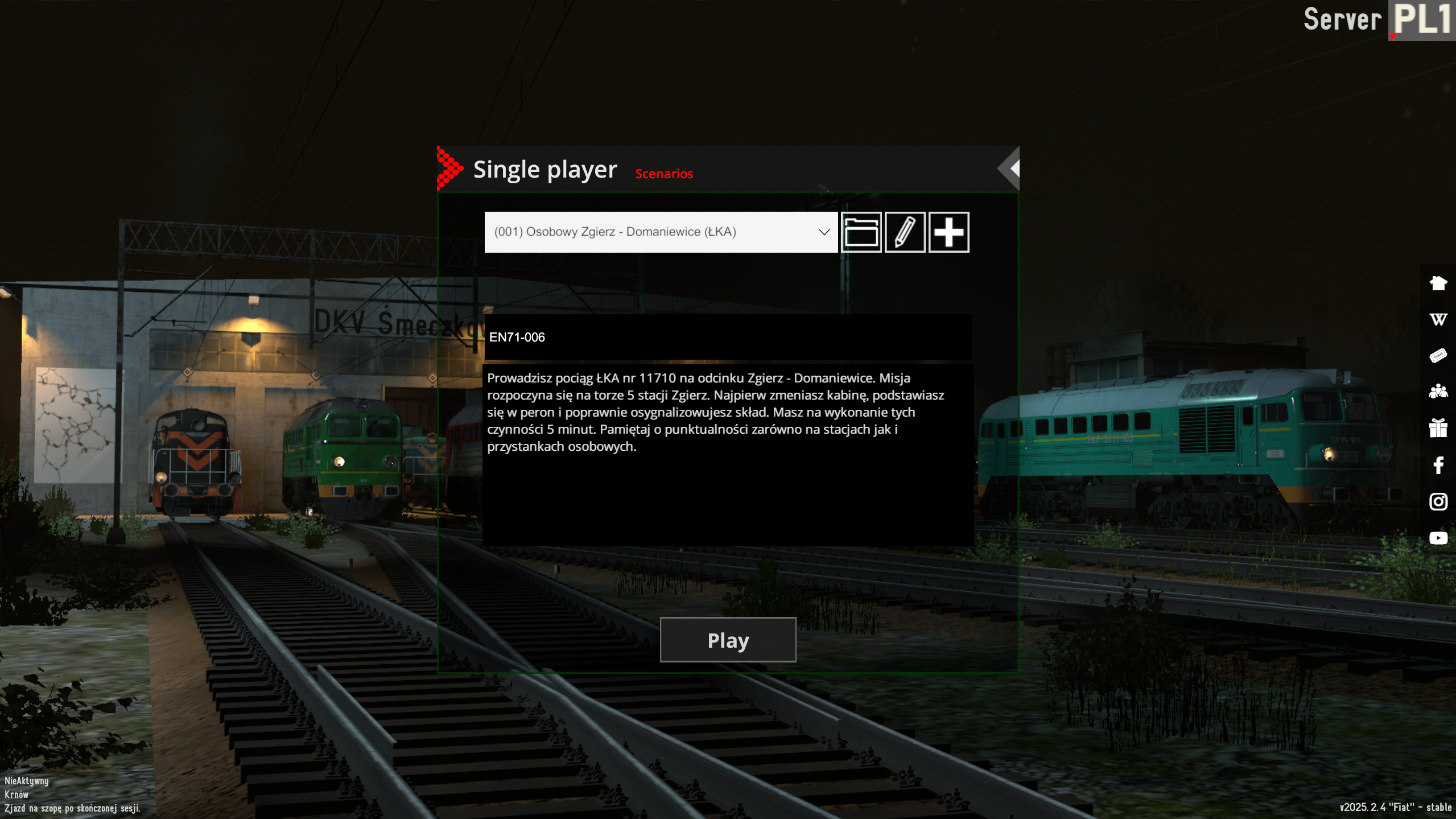
1. Selecting a Train
- Single-Player Mode: Trains are typically bound to specific routes (Scenery). To change this, click the “pencil icon” on the right side of the screen to edit.
- Multiplayer Mode: Select an available train directly from the drop-down menu at the top.
- Key Parameters: Be sure to pay attention to the train’s Length, Weight, and Vmax (Max Speed), as these directly affect your braking distance and scheduling permissions.
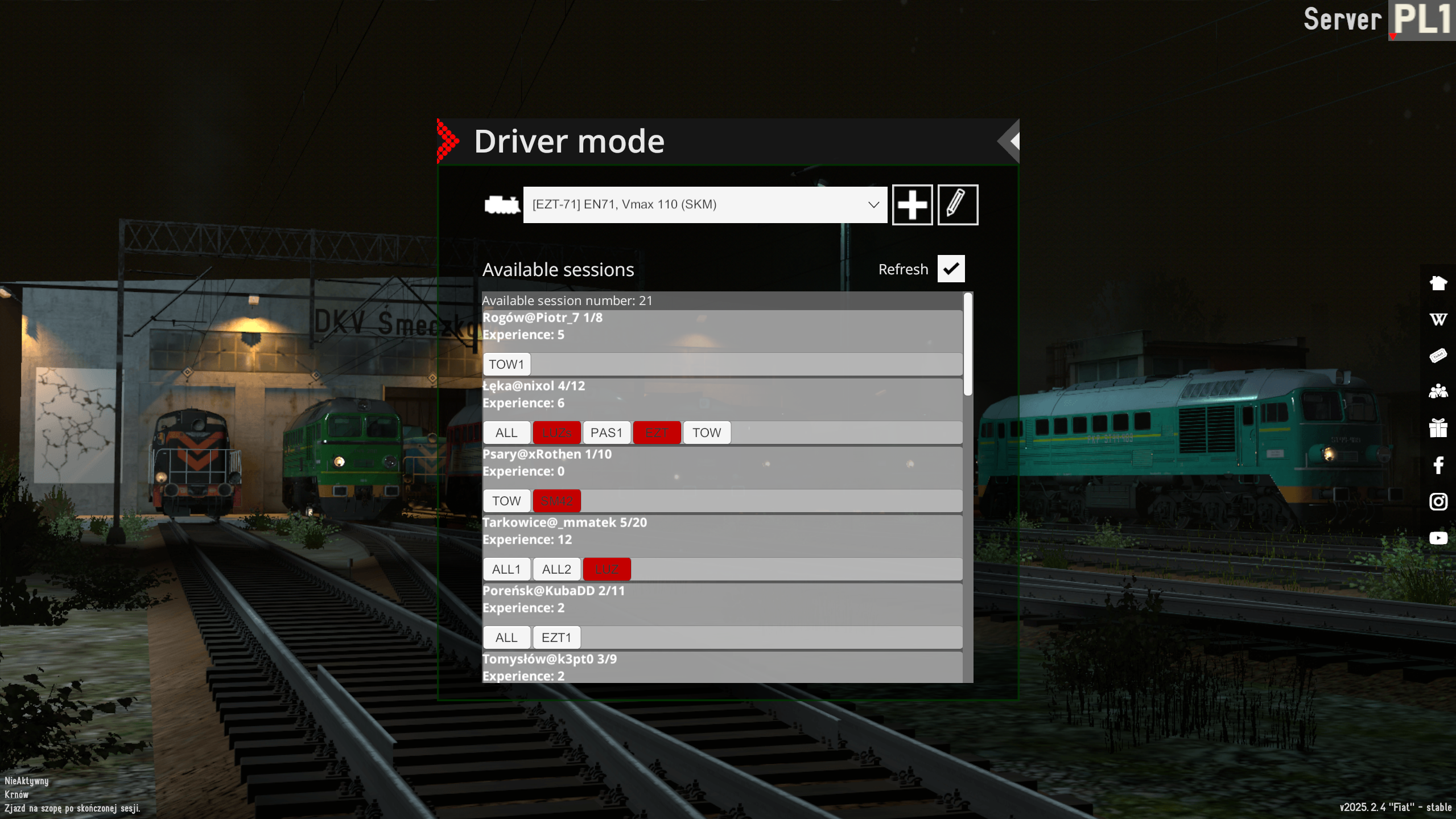
2. Select Spawn Point
Click the white button on the map to spawn. Different abbreviations represent the applicable train types:
- ALL: Any train type.
- LUZ: Light Engine (single locomotive).
- PAS: Standard passenger train.
- OSOB: Commuter/slow passenger train.
- EZT: Electric Multiple Unit (EMU) or Diesel Multiple Unit (DMU).
II. Multiplayer: Requesting a Schedule
In multiplayer sessions, drivers must proactively request a schedule from the Dispatcher. Please send the following format in the chat room:
First, adjust your train number to match the corresponding digit in the table below
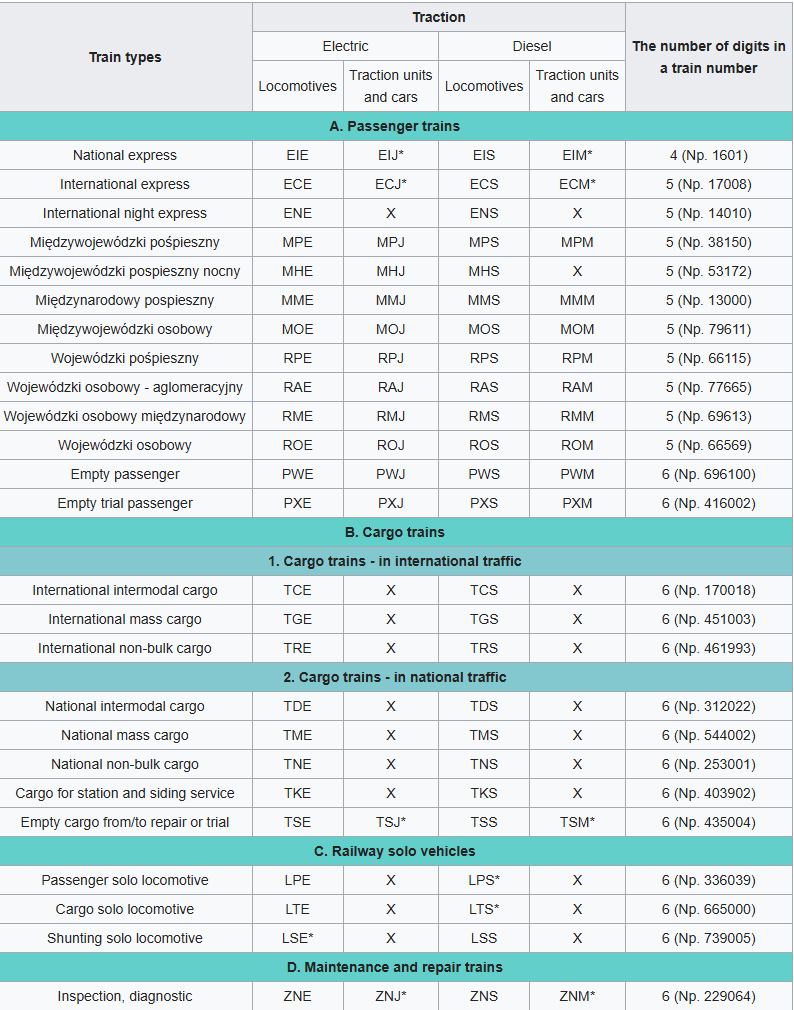
Request Format:
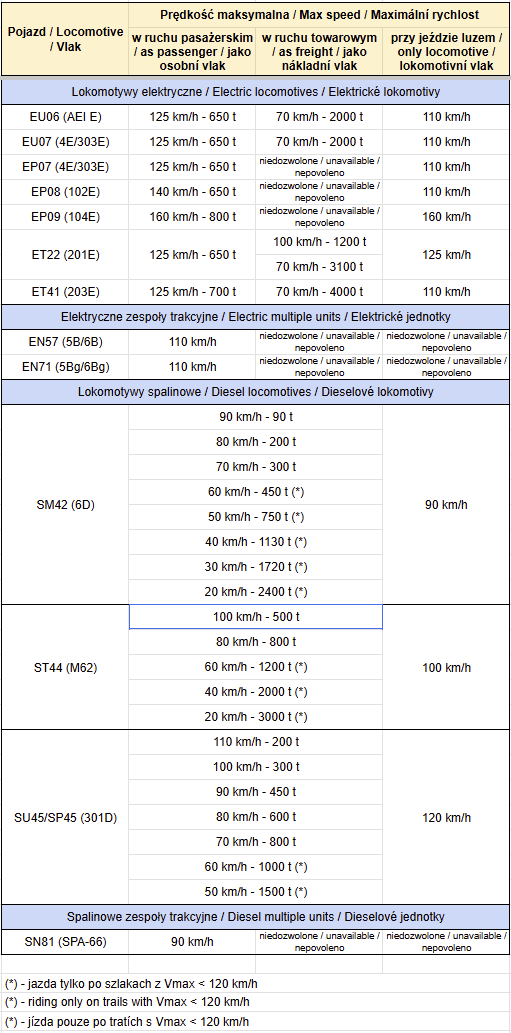
<Type> <Lead Locomotive> Vmax<Speed Limit> <Estimated Duration>Example:LPE EP09 Vmax160 1 hour please
You can look up Vmax values in the table below
III. Driving UI Interface Guide
The image below shows the layout of the core instruments during driving. Please familiarize yourself with their locations to facilitate quick responses in emergencies.
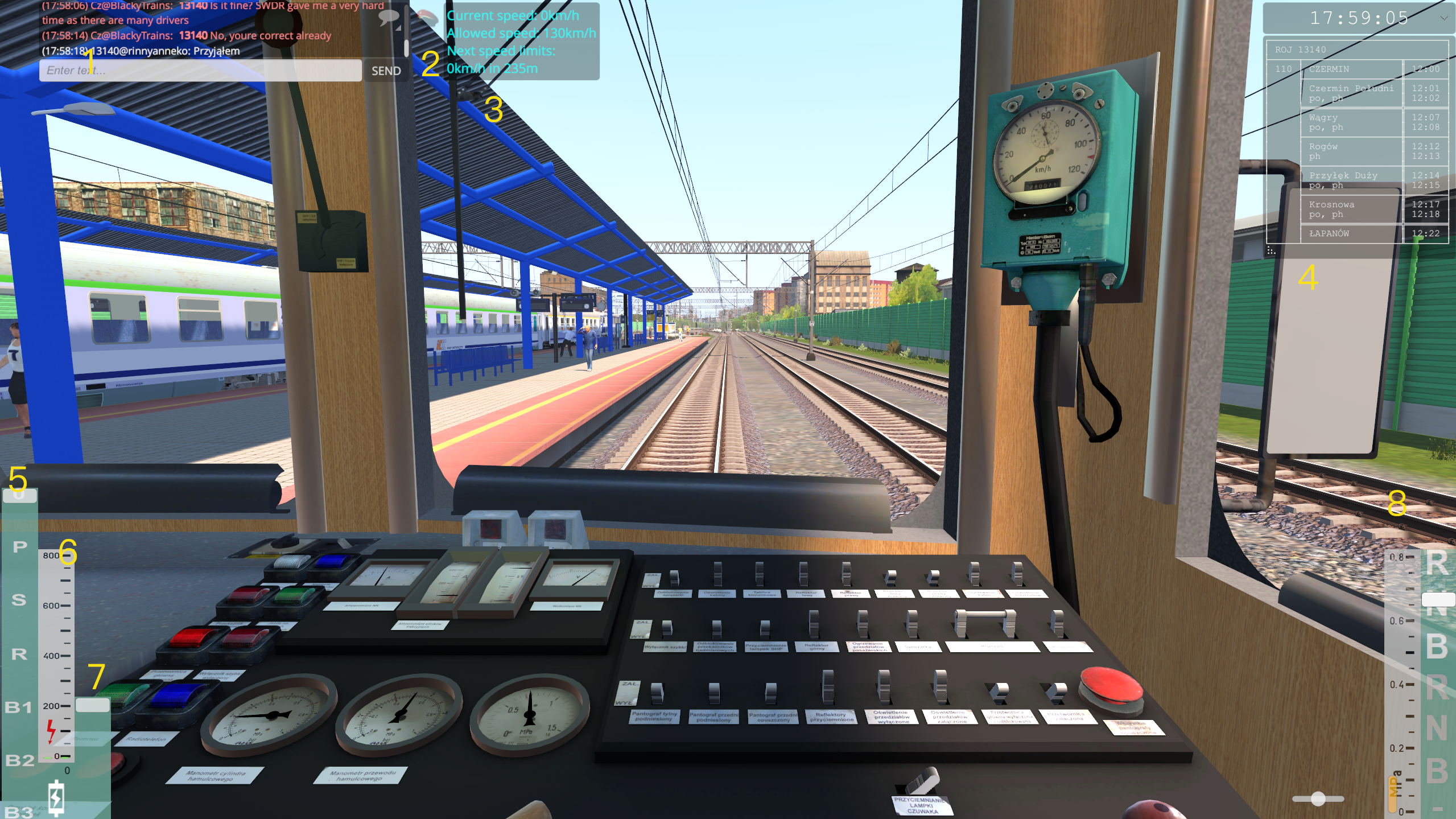
- Chat Box: Communicate with the dispatcher.
- Player List: Tap to expand and view currently online players.
- Speedometer: Displays current speed and the speed limit for the section.
- Timetable: Displays stops and estimated arrival times.
- Traction/Regenerative Control: Controls traction.
- Amperemeter: Monitors current (turns red at the bottom when a circuit breaker trips).
- Reverser: Controls the direction of travel.
- Brake Gauge: Displays air pressure in the master cylinder and brake cylinders.
IV. Polish Railway Signal Recognition (Key Points)
Polish railways use a unique colour-light system; understanding these signals is critical for safe operation.
1. Identifying Signal Types
- Absolute Signal (red-and-white post): Semi-automatic control; under no circumstances may a red light be passed without permission.
- Permissive Signal (white post): Automatic block signal, indicating the status of the block section ahead.
- Advance Signal: Features a white light at the bottom to indicate the colour of the next main signal.
2. Meaning of Common Signal Colours
| Code | Display | Meaning |
|---|---|---|
| S1 | Red light | Stop. |
| S2 | Green light | Proceed at the speed limit (Vmax). |
| S5 | Flashing yellow light | Prepare to stop; the next signal is S1. |
| Sz | Flashing white light | Substitute Signal: Permitted to pass at 40 km/h or below; be prepared to stop at any time. |
V. Driving Instructions
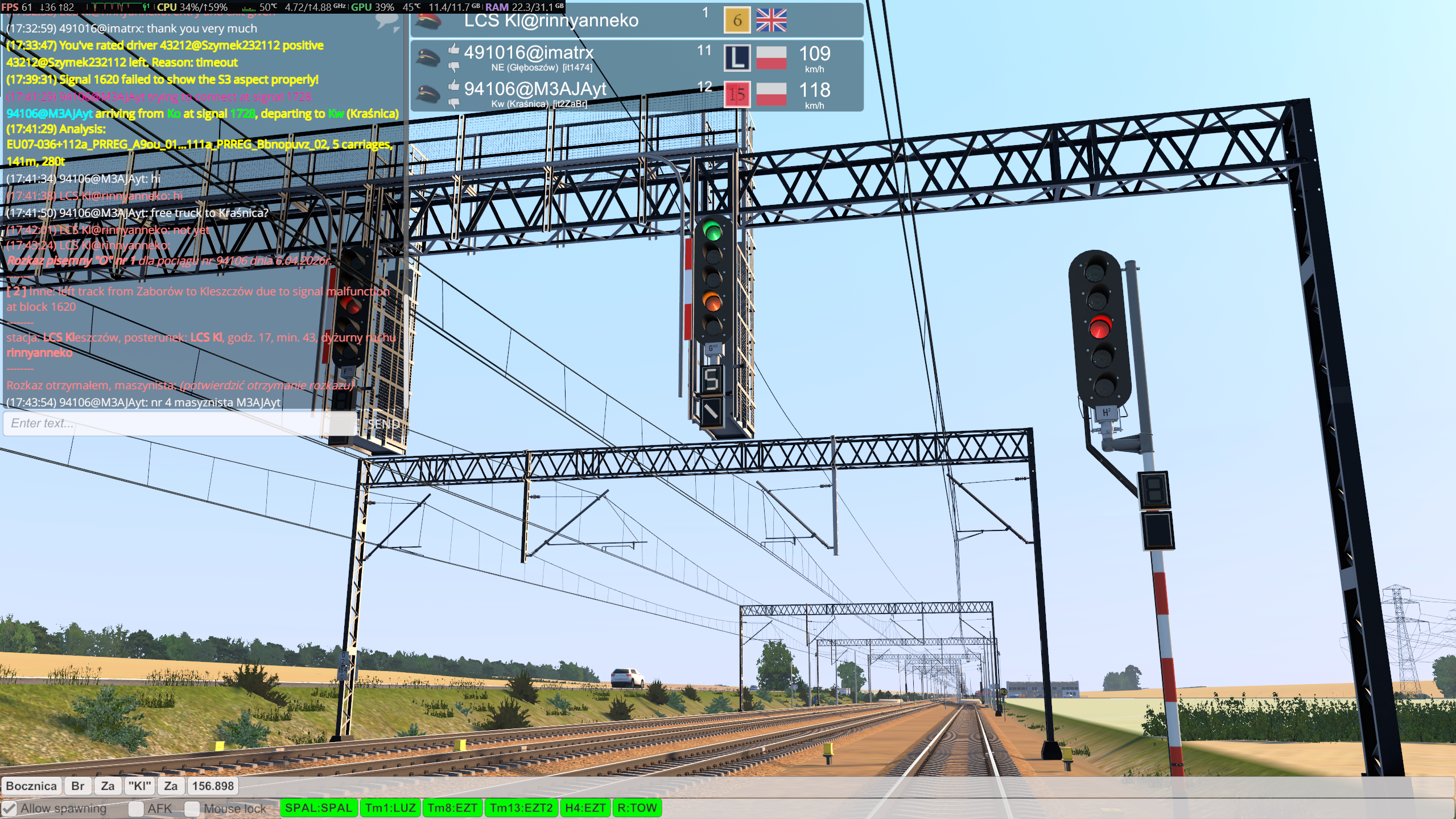
Driving instructions are a written document used when operations cannot be communicated via traffic lights; in TD2, they are transmitted through the radio chat window.
Below is the description from the wiki, translated using DeepL
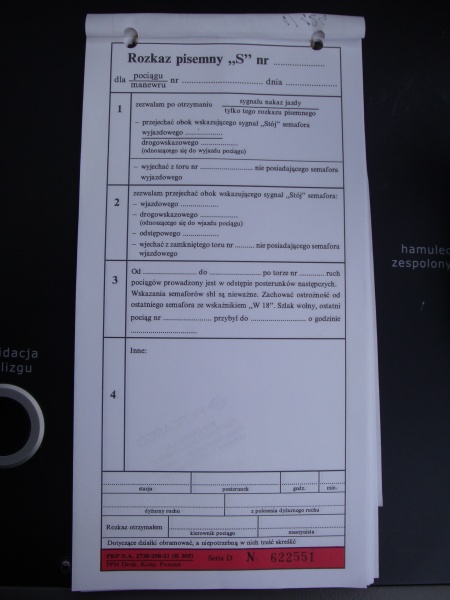
Written Order "O" (Rozkaz pisemny "O")
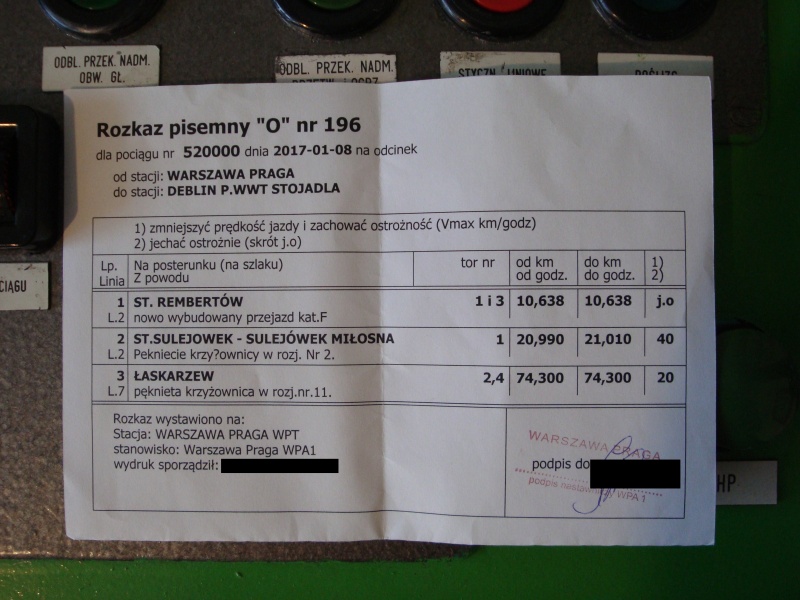
The written order "O" is used to convey the following instructions and information to the driver:
- Instructions and information regarding cautious operation—for the following reasons:
a) Failure to notify the level crossing guard or the works supervisor: situations such as a train changing its primary direction of travel on the route track or running on a closed track;
b) Failure to receive confirmation of the arrival of auxiliary vehicles or notification that they have been removed from the route track;
c) During track construction, the traction crew must be ordered to display the “Caution” signal,
d) When the train is carrying special cargo,
e) When there are cars carrying special cargo on an adjacent main track or station track, and if such a warning is required, the train must proceed on that track,
f) When one of two main tracks is closed and single-track bidirectional operation is in effect on the active track, or when bidirectional operation is in effect on both active main tracks, and the line signaling system is not equipped for such operation, the train must proceed in the direction of the main track,
g) When the locomotive crew is unfamiliar with the section of track being traversed, and such familiarity is necessary for operating a train on that section (including permanent and temporary warnings, sections using multi-block (automatic) line block systems, construction sites, locations where radio channels change, train speeds permitted by the internal timetable and the corresponding kilometre intervals, locations of road–rail level crossings and controlled passages, as well as other circumstances affecting railway traffic safety); - provided that the permitted speed for trains on that section (route) does not exceed 40 km/h (Article 16, Paragraph 3),
h) Other situations requiring cautious driving,
- Issue a cautious driving order and simultaneously reduce speed for the following reasons:
a) Changing the approach track under the circumstances described in Article 37, Paragraph 3
b) When a train enters a partially occupied track, or under special circumstances enters a track terminated by a stop block (Article 37, Paragraphs 9 and 10), or enters a track where the speed limit is lower than that indicated by the signal (Article 41, Paragraph 16, Item 5),
c) The condition of the rolling stock,
d) The condition or type of cargo requiring a speed restriction,
e) The condition of the track surface and civil engineering structures,
f) The condition of the train control system (SRK) equipment,
g) the condition of the traction network equipment,
h) failure to notify the level crossing attendant or the engineering supervisor (if temporary operating regulations require notification of the engineering supervisor) of the departure of a train or auxiliary vehicle,
i) Failure of traffic safety equipment at the railway level crossings and crossing points under one’s responsibility, and the inability to arrange for qualified personnel to direct road traffic; and within the range of influence of a train equipped with an SSP (Automatic Level Crossing System), where the “Caution” signal must be repeatedly issued until the W6b indicator is set to the correct position,
j) The locomotive crew is unfamiliar with the section of track under their responsibility, where familiarity with that section is a prerequisite for operating a train on that section (permanent and temporary warnings, sections using multi-interval (automatic) track interlocking, construction sites, radio channel change points, train permitted speeds and their change points as specified in the internal timetable, locations of railroad crossings and controlled passages, and other circumstances affecting railway traffic safety),
k) Other situations requiring speed restrictions,
l) When a stop is required due to damage to infrastructure or level crossing components or a fire, and the train must pass through the damaged section at a specified speed; if necessary, the train must be operated under supervision (guided by a signalman), m) After the signal post is opened (§56, Paragraph 23)
Written Order "S" (Rozkaz pisemny "S")
The written order "S" is used to issue the following permissions, instructions, and information to the traction and shunting crews:
- Permission for the train to pass through a departure signal displaying "Stop," an unclear signal, a white light, or an unlit signal, provided that an alternative signal "Sz", and must specify whether this permission is valid only after receiving the Rd1 "Proceed" signal or takes effect without receiving that signal (provided it complies with the provisions of Article 63, Paragraph 9), as well as permission to pass departure signal lights located within the jurisdiction of a deactivated control centre (Article 56, Paragraph 61);
- Permission to depart from a station equipped with a departure signal, where such permission involves tracks not equipped with a departure signal, and it must be specified whether the permission is valid only upon receipt of the Rd1 “Proceed” signal, or whether it takes effect without the need to receive such a signal;
- Permission for a train to pass an approach signal, route indicator signal, manually operated block signals or barriers, including cases where a suspicious signal, a white light, or no illumination is displayed, provided that an alternative signal “Sz” cannot be issued—with the exception that when a semaphore signal displays a “Stop” signal at night or is unlit during dark hours, while a daytime signal clearly displays a permissive signal, the daytime signal shall prevail; provided that no D1 “Stop” barrier is installed in front of the signal—as well as allowing trains to pass through an entry-point semaphore within the jurisdiction of the signal post (which has been excluded from dispatching operations) (§56, para. 61),
- Information regarding the first train traveling on the right-hand track (main direction of travel) when a unidirectional multi-section (automatic) block system is used in the circumstances described in Article 52, Paragraph 17, Item 1,
- In the circumstances specified in Article 12, Paragraph 4, Item 1, permission is granted for shunting operations along the direction of the running route beyond the designated shunting area or the final turnout (track junction),
- Permission is granted to enter from a closed track section where no entry signal is installed,
- Permission to proceed when the traction unit is located beyond a signal displaying a permissive indication and the train operator cannot see the signal,
7a) Permission to continue when the front end of a stopped train has passed a signal displaying the W24 indication and the train is directed to the right-hand track,
- Trains are permitted to pass the D 1 “Stop” sign (§ 46, Paragraph 8, Item 5, and § 63, Paragraph 9),
- When the front end of a train has passed a controlled signal and the rear end has passed the rear-end position indicated by the signal but has not yet passed the rear-end position indicated by the proceed indication, the stopped train is permitted to continue; or when the train has passed and is stopped behind a signal displaying a “Stop” indication (Annex 4a),
- Authorizing track-road vehicles (PSD) suitable for both road and rail operation to enter the station and proceed (Section 81, Paragraph 13),
- Instructing a train to proceed on a single-track route to a specified kilometre point and to stop and turn back no later than a specified time—provided that the train’s movement is not included in the internal timetable,
12) Direct a locomotive coupled to the train, or a locomotive not coupled to the train but following it to the next station, to push or pull the train (from … to …), specifying the stopping position of the pushing or pulling locomotive at that station, or to return from a single-track route to the originating station—provided that the internal timetable does not require pushing operations,13) Instruct a train to run on a closed section of track, provided the conditions described in Article 53, Paragraph 11 are met, 14) Directing a train to stop at a station not listed in the timetable, applicable to the situations described in Article 47, Paragraphs 3 and 4; or to stop on the route, applicable to the situation described in Article 67, Paragraph 1, Item 2,15) Ordering a train to make a stop on the route not provided for in the internal timetable, and specifying the purpose and time of the stop,
16) Order the uncoupling of locomotives before a location (bridge) where double-locomotive traction is prohibited, pass the location with a single locomotive, and recouple after the location; provided, however, that this does not apply if uncoupling is not specified in the internal timetable,

17) Order a train to stop before a semaphore signal that is faulty but still operational (§ 46, Article 9, Paragraph 1, Item d),

18) Information regarding the circumstances under which entry is permitted for trains or shunting units returning from a single-track line, if their entry is not based on a permissive signal from the station signal or the signal’s substitute signal “Sz”; If shunting operations are included in the internal timetable, this information must be communicated to the shunting crew; if this situation is governed by siding operation regulations and the crew is familiar with those regulations, it must be communicated to the siding train crew;

19) Information regarding changes to the internal train schedule, including: the addition or cancellation of stops, the permanent opening or permanent closure of a marshalling yard, the temporary closure of a marshalling yard, changes to the route ordered by authority, and the location of passenger stations; prior to the effective date of changes to the internal train schedule, train crews shall be notified by written order;

20) Information regarding the addition or relocation of signal locations, as well as changes to signal display patterns that have a significant impact on the train; Such changes shall be communicated to train crews via written orders within 14 days of the change taking effect,
21) Information regarding the temporary opening of normally closed signal posts; train crews shall be notified throughout the period the post is open, or, if the internal train schedule is amended, within 14 days of the amendment,
22) Information regarding the activation of temporary interval (siding) or branch line signal posts and their locations (route … km …), specifying the signal authorizing the train to pass through the signal post; the train crew shall be notified throughout the entire period the signal post is active,

23) Information regarding the invalidation of signals on interval-based automatic signaling systems during train dispatching in subsequent station sections (§ 29, Paragraph 4),
24) Information regarding malfunctions of trackside train control equipment (SHP, ERTMS/ETCS, etc.),
25) Information regarding a train’s direction of travel not conforming to the internal timetable; if such an instruction is not issued by the dispatcher at the preceding station, it shall be issued to the train crew by the dispatcher who directs the train to travel in the opposite direction,26) Information regarding track opening and the resumption of double-track operation; if the train crew has received a written instruction requiring the train to run on the left track (opposite the primary direction of travel), but the actual route will be changed to the right track (primary direction of travel) (Appendix 4b),
27) Information and instructions regarding operational trains that have already departed and are located on a closed track (Article 53, Paragraph 12),

28) Information regarding the closure of a rear signal post and its withdrawal from traffic control, the failure of semaphore signals at a rear signal post that has been withdrawn from traffic control, the failure of signals and semaphore signals in multi-section (automatic) line interlocking systems, and speed restrictions within the area of a closed rear signal post that has been withdrawn from traffic control (Article 56, Paragraph 35),

29) Information regarding the failure of level crossing warning signs at controlled railway level crossings and passages equipped with road traffic control,
30) Information regarding the failure of signals on signal machines permitting train movement (Section 46, Article 9, Paragraph 2, Subparagraph d),
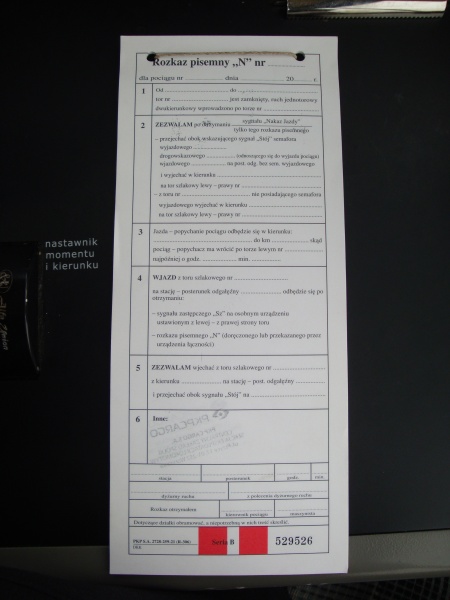
31) Information regarding authorized personnel entering the driver’s cab of a railway vehicle (§ 67, Article 1, Paragraph 2).廣告 · Advertisement支持本站Written Order "N" (Rozkaz pisemny "N")
The written order "N" is used to issue the following permissions, instructions, and information to the locomotive crew:1) Permission for a train to pass a departure signal displaying "Stop" and enter the left-hand main track (opposite the main direction of travel), provided that the departure signal does not display "Sz," and it must be specified whether this permission takes effect only after receiving the "Rd 1" signal ("Proceed" signal) or whether it takes effect without the need to receive that signal, 2) Permission for the train to enter from the left-hand track (opposite the main running direction) at a station where no entry signal or other signaling device is installed, or when the corresponding signal cannot be displayed at that location, 3) Permits a train to depart from a station equipped with a departure signal onto a track without a departure signal and enter the left-hand main line (opposite the primary direction of travel), and specifies whether this permission is valid only after receiving the Rd 1 “Proceed” signal, or whether it takes effect without the need to receive that signal,4) Information regarding main line closures and the implementation of single-track two-way operation on active main lines (see, however, Section 21),
- Information regarding the conditions for permission for a train or return handcar to enter from the left-hand main track (opposite the main direction of travel), if such entry is not based on a permissive signal displayed by the entry signal located on that track, or on the “Sz” signal on that signal; If the pushcar operation is included in the internal timetable, this information must be communicated to the pushcar crew; if this situation is governed by siding operation regulations, it must be communicated to the siding train crew;
- When a train travels on the left-hand track (opposite the main direction of travel) and passes through an interval (siding) post, it may proceed only after receiving the Rm1-type “Toward Me” hand signal from the respective post attendant;
- Information regarding bidirectional operation on double-track main lines when both tracks are in service and the line interlocking system is not equipped with bidirectional operation functionality; this information shall be provided to the train crew entering the left-hand main track (opposite the main direction of travel) to perform bidirectional operation;
- Information regarding the specific location on the double-track line where the train will proceed or be pushed; and if the situation of proceeding or being pushed to a designated kilometre point on the line and then returning is not included in the internal timetable, a return order shall be issued; in this case, the latest time for returning to the departure station must also be provided to the train crew.
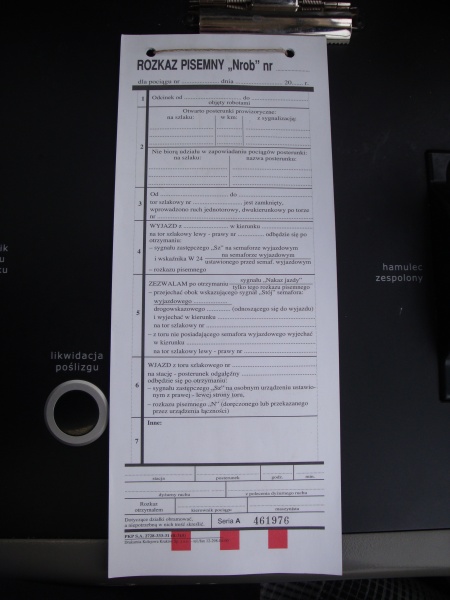
Written Order "Nrob" (Rozkaz pisemny "Nrob")
During scheduled track closures due to construction, the written order "Nrob" may be used to replace the written order "N" or the order "S" (§ 56, Paragraph 57), provided the relevant fields are filled out. A single "N" or "Nrob" order may only contain data resulting from a single main track closure.
Train Order Generator
You probably won’t need this for actual operations, but it’s fun to play around with.
https://generator-td2.spythere.eu/
廣告 · Advertisement支持本站VI. Essential Phrases for Multiplayer
Most people can understand simple English, but knowing these phrases will help you fit in better with the player community
Witam / cześć / bry / hej Hello
Rozkład jazdy (RJ) Timetable
Dyżurny ruchu Dispatcher
Maszynista Driver
Pociąg Train
Manewr Shunting
Zmiana kabiny Cab change
Stój Stop
podany (signal) Signal given
Przyjąłem Received / Copy
Gotowy do odjazdu Ready to depart
Odjazd Departure
Wjazd Arrival
Wyjazd Departure
Co z wjazdem? (Request to enter)
Za chwilę Just a moment
Proceed on Substitute Signal (Sz)
Proceed on Left Track
Free
Yes
No
Passing through this station
Goodbye / ++
/swdr <message> Send a message to all dispatchersKoniec End
Nowy rozkład/RJ New timetable
Rozkaz pisemny Written order
7. Auxiliary Software and Translation
Since the game community is primarily Polish-speaking, we strongly recommend using:
- TD2-Translator: Provides real-time translation of chat messages.
- Browser Recommendation: When browsing the official forum, it is recommended to translate to English rather than Chinese to avoid confusion with railway terminology.
If you have any questions, feel free to leave a comment below or join the QQ group
876515952to discuss!